The Karakoram, defined by its extreme topography, volatile microclimates, and severe glaciological hazards, has long been the ultimate proving ground for high-altitude alpinism. On July 30, 2026, its dangers were tragically underscored when a catastrophic slab avalanche swept across the upper slopes of Broad Peak (8,051 m), the twelfth-highest mountain in the world. The disaster killed ten highly experienced climbers, including the renowned Nepali-British mountaineer Nirmal "Nimsdai" Purja, a 100 percent fatality rate for the summit team.
It stands as one of the deadliest single events in Broad Peak's history and the most severe Karakoram catastrophe since the 2008 K2 disaster. Triggered at roughly 6,600 meters, the avalanche was the product of an anomalous snow-loading period, high-stakes decision-making under psychological pressure, and a cascading failure in emergency communication. The aftermath, a twelve-hour delay before rescue protocols began, and confusion caused by anomalous satellite telemetry, exposed critical gaps in how commercial Karakoram expeditions are run.
This piece reconstructs the day: the glaciological and meteorological setup, who was on the mountain, the mechanics of the fracture, the communication breakdown now known as the "12-hour silence," and the recovery mission led by Mingma G, drawing on official statements from Elite Exped and the Alpine Club of Pakistan, satellite telemetry, and eyewitness accounts from neighboring base camps.
Glaciological Topography and Meteorological Preconditions
To understand the mechanics of the July 30 avalanche, it helps to start with Broad Peak's glaciological profile and the meteorological anomalies that defined the summer of 2026 in Gilgit-Baltistan.
The Accumulation Zone and the West Ridge
Broad Peak, known locally as Falchan Kangri, has an expansive summit ridge stretching nearly 1.5 kilometers. The standard route follows the West Ridge, forcing climbers through a notoriously hazardous corridor between Camp 2 (~6,166 m) and Camp 3 (~7,000 m), steep, open snowfields interspersed with gullies that funnel descending ice and snow.
That terrain sits at 30–50 degrees, the precise gradient window where slab avalanches are most likely to form. Below 30 degrees, snow tends to settle and bond; above 50 degrees, it sloughs off continuously rather than accumulating. Within the 30–50 degree band, snow can build into cohesive slabs resting on unstable underlying layers, needing only a minor stressor to fracture.
The July Weather Anomaly and Snowpack Instability
Conditions deteriorated rapidly in the weeks before the disaster. From around July 18, the upper mountain was hit by severe gales and elevated humidity, followed by heavy, erratic snowfall starting July 22 that persisted for days, loading immense volumes of fresh, unconsolidated snow onto the upper flanks.
That fresh snow failed to bond with the older, metamorphosed layers beneath it, creating a highly unstable weak layer. Several independent climbers and teams recognized the danger and pulled out, most notably Hungarian climber David Klein and American ER nurse Ian Overton, who were attempting a no-O2 ascent and retreated on July 25, five days before the avalanche.
Klein later explained the specific hazard: after a major snowfall event, a break in precipitation alone isn't enough to climb safely. The snowpack needs several consecutive clear days to either bond to the mountain or naturally slide off. Overton corroborated this, reporting the snowpack below Camp 2 was visibly disintegrating and remained unconsolidated.
The "Blue Sky Illusion"
Despite that loaded slope, July 30 brought clear, calm skies, what avalanche-risk assessors call the "blue sky illusion," where a sunny day right after a major storm masks the invisible instability buried beneath climbers' boots.
The pressure to use a narrow late-season weather window often overrides environmental caution, a pattern risk-management researchers call "normalization of deviance," and one that appears to have shaped the decision to launch the summit push that morning.
Expedition Composition: A Convergence of Elite Alpinists
The ten climbers who died were not amateurs, they represented a cross-section of the most capable high-altitude mountaineers, veteran Sherpa guides, and international clients working in commercial climbing today, drawn from four teams operating concurrently on the mountain: Elite Exped, Imagine Nepal, Seven Summit Treks, and the local Pakistani outfitter Moving Mountains.
Nirmal "Nimsdai" Purja and the Pressure of the Record
Purja's presence inherently shifted the expedition's risk calculus. Born in Nepal's Myagdi District, he served 16 years in the British military and became the first Gurkha to join the Royal Navy's Special Boat Service. He redefined high-altitude mountaineering in 2019 with "Project Possible," summiting all fourteen 8,000-meter peaks in six months and six days, documented in the Netflix film 14 Peaks: Nothing Is Impossible.
In summer 2026 he was chasing a new goal: becoming the first person to summit all fourteen 8,000ers twice, entirely without supplemental oxygen. Broad Peak wasn't originally on the itinerary, his main Pakistan objective was Gasherbrum II, summited without oxygen on July 21, but the logistics meant Broad Peak would leave only Cho Oyu to complete the goal. He announced the late addition on July 27, posting that he took "zero mountains for granted" and asked only for safe passage.
His career wasn't without controversy: Nepal's Department of Tourism had investigated him and Elite Exped over unauthorized helicopter flights to Everest Camp II, and he faced criticism over compensation following a 2022 oxygen-cylinder explosion at an Elite Exped facility. Earlier records were scrutinized for stopping at the fore-summits of Dhaulagiri and Manaslu (later corrected), and a New York Times investigation detailed allegations of unwanted sexual advances. None of that diminished his logistical capability or endurance, he remained a gravitational force on the mountain.
The Victims: Guides, Clients, and Local Advocates
The expedition included some of the most capable high-altitude workers in the world; their loss is a significant blow to Nepali and Pakistani climbing talent.
Sohail Sakhi's death carries particular weight. A year before the disaster, Sakhi had publicly warned about the Karakoram's lack of rescue infrastructure and advocated for a mandatory, funded rescue team supported by expedition fees, noting bluntly that rescue in the region was "often very expensive and nearly impossible". His warning would prove prophetic in the hours after the avalanche.
The Strike: Chronology of the 6,600-Meter Trigger
By the early hours of July 30, the ten climbers had committed to the summit push. Garmin inReach telemetry from Purja's and Al Harthy's devices shows departure from Camp 2 at approximately 5:33 AM local time. The team moved into the hazardous, snow-loaded gully between Camp 2 and Camp 3, where fixed ropes were partially buried or missing after the recent storms.
The Mechanics of the Fracture
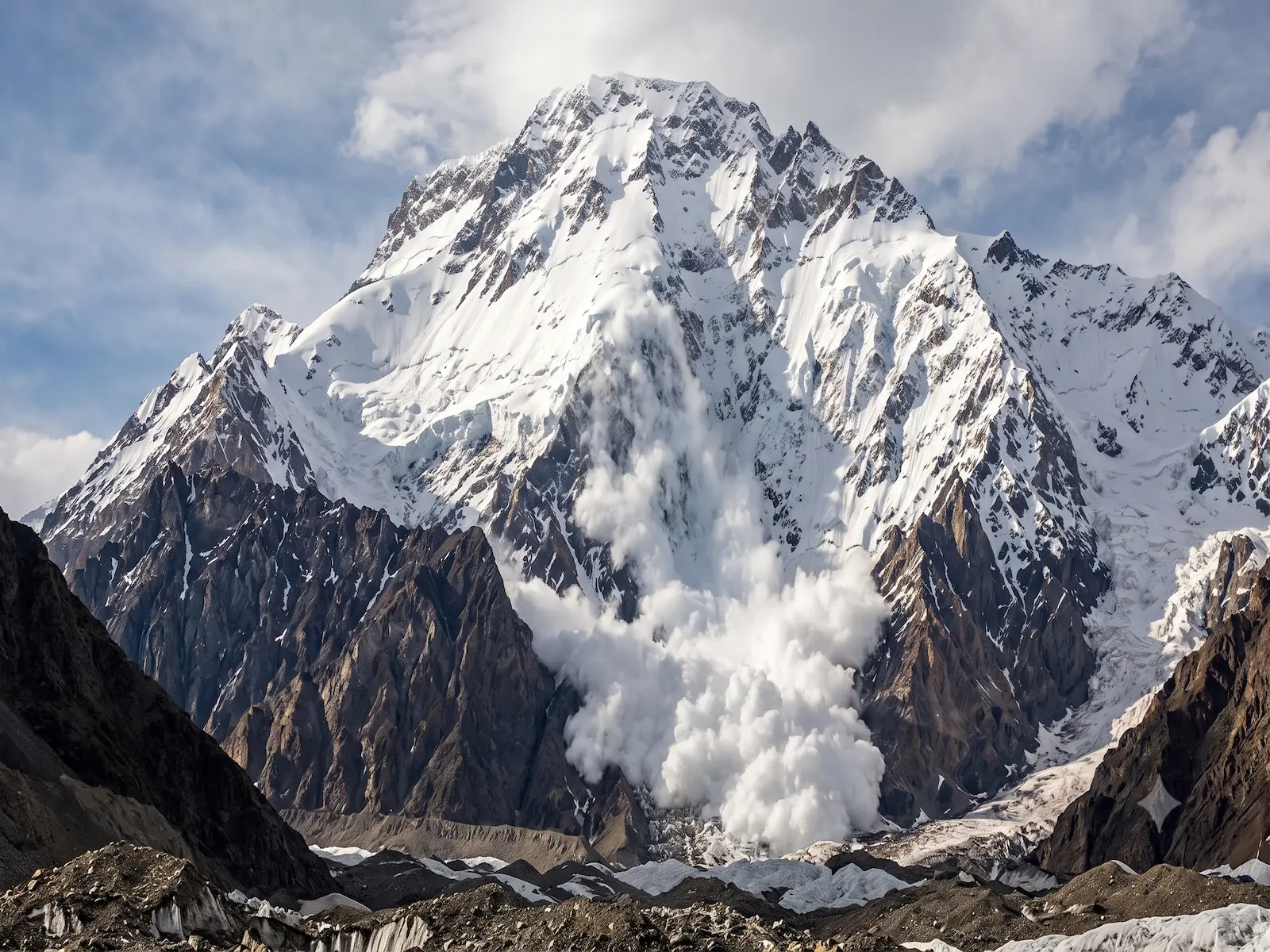
At approximately 8:57 AM, the snowpack failed catastrophically at roughly 6,600 meters. The most probable mechanical trigger was the localized weight of ten climbers moving across an unconsolidated slab resting on an unstable basal layer.
It was a slab avalanche, a large, cohesive plate of snow releasing simultaneously over a wide area, rather than a loose-snow point release. Base Camp eyewitnesses reported seeing the release send a shockwave of pulverized ice and snow down the west face.
The Fall
Satellite GPS trackers recorded a violent, near-vertical loss of elevation. Climbers were swept between 700 and 1,500 vertical meters. Purja's device recorded an ~800-meter drop, stopping at 5,878 m; Al Harthy's indicated she was carried nearly to the foot of the mountain, a drop of more than 5,000 feet.
Survival in a slab avalanche of this scale on a 50-degree slope is statistically almost impossible. The primary causes of death in events like this are blunt-force trauma from collisions with rock, ice, and bedrock during a fall of this length, and asphyxiation from deep burial. Rescue analysts concluded all ten victims likely suffered rapid, unsurvivable injuries within moments of the fracture.
Telemetry Anomalies and the Fatal Twelve-Hour Silence
One of the most scrutinized aspects of this disaster is the delay between Base Camp witnessing the avalanche and regional rescue authorities being formally notified, the "12-hour silence" that closed the only daylight window for an aerial response.
The Base Camp Blackout
At 9:00 AM, minutes after the fracture, Base Camp personnel visually witnessed the slide and permanently lost VHF radio contact with the summit team. Despite this near-certain confirmation of a mass-casualty event, formal state-level emergency protocols weren't triggered immediately.
Journalist Ben Ayers of Everest Live later reconstructed the gap based on firsthand accounts, including from Jenjen Lama, who was managing the neighboring K2 base camp and witnessed the avalanche. Rather than an immediate state-level alert, Base Camp staff spent hours attempting contact and triangulating radio and GPS signals with nearby teams to confirm what had happened.
The Gilgit-Baltistan Commissioner's Office wasn't formally notified until 8:00 PM, eleven hours after the avalanche, and the Alpine Club of Pakistan, through spokesperson Naila Kiani, not until roughly 10:00 PM, thirteen hours post-incident. By then, night had fallen and the day's window for Askari Aviation helicopters was gone. "If we had received the news on time, we could have dispatched search and rescue helicopters before darkness fell. We lost that critical window of opportunity," Kiani told the press.
The delay appears rooted in organizational paralysis as much as anything technical: Base Camp staff, recognizing the scale of the slide, understood almost immediately that this was a non-survivable event, and without a designated emergency command role at Base Camp, that recognition translated into hours of inaction rather than an immediate call up the chain.
Garmin "Ghost Signals"
The blackout was compounded by strange telemetry. In the early hours of July 31, Purja's Garmin inReach registered a micro-movement at the 5,878-meter mark, initially read by some, including Elite Exped co-founder Mingma David Sherpa, as a possible sign of survival, and briefly raising hope across the climbing community.
Ben Ayers and Everest Live later clarified what was actually happening: consumer GPS devices in extreme alpine environments can suffer triangulation errors, "ghost signals" or GPS drift, where a stationary unit against rock or in a crevasse shows small positional wander from atmospheric interference and signal reflection, despite zero actual velocity. The tracker was bouncing signals off the debris field, not indicating survival.
Timeline at a Glance
|
When |
What happened |
|
Jul 18 |
Severe gales and rising humidity begin battering Broad Peak's upper elevations. |
|
Jul 22 |
Heavy, erratic snowfall starts, loading fresh unconsolidated snow onto the upper flanks. |
|
Jul 25 |
David Klein and Ian Overton abandon their no-O2 summit bid and retreat, five days before the avalanche. |
|
Jul 27 |
Nirmal Purja publicly announces Broad Peak as a late addition to his itinerary. |
|
Jul 30, 5:33 AM |
Garmin inReach telemetry shows the ten-member team departing Camp 2 (~6,166 m). |
|
Jul 30, 8:57 AM |
The snowpack fractures at ~6,600 m; a massive slab avalanche sweeps the team down the west face. |
|
Jul 30, 9:00 AM |
Base Camp personnel witness the slide and permanently lose VHF radio contact with the team. |
|
Jul 30, 8:00 PM |
The Gilgit-Baltistan Commissioner's Office is formally notified, 11 hours after the avalanche. |
|
Jul 30, 10:00 PM |
The Alpine Club of Pakistan is notified, 13 hours after the avalanche; the daylight helicopter window is lost. |
|
Jul 31 |
Askari Aviation helicopters deploy; the operation shifts from rescue to recovery. Drone footage confirms seven bodies on the West Face. |
|
Jul 31 |
Ground teams recover the remains of Nadhira Al Harthy, Pur Bahadur Gurung, and Mallory Geis. |
|
Aug 1 |
Elite Exped officially confirms the deaths of Nirmal Purja and the rest of the team. |
|
Aug 2 |
A ten-person team led by Mingma G recovers four more bodies, Purja, Kili Pemba Sherpa, Nima Sherpa, and Wang Zhong, from ~5,700 m before two secondary avalanches force the recovery to halt. |
The Recovery Mission: Mingma G and the Karakoram Response
By the morning of July 31, the operation shifted from rescue to high-altitude body recovery. The response from the mountaineering community was immediate: teams on neighboring K2, including one led by the highly respected Mingma Gyalje Sherpa (Mingma G) of Imagine Nepal, abandoned their own summit pushes to redirect resources to Broad Peak.
Major General Irfan Arshad Khan, President of the Alpine Club of Pakistan, confirmed the deployment of military Askari Aviation helicopters and said every possible resource was being mobilized, weather permitting.
Drone Deployment and Aerial Reconnaissance
The terrain made a blind ground search suicidal given the risk of secondary avalanches, so Mingma G deployed high-altitude drones to survey the West Face. The drone footage bypassed the glitching Garmin trackers entirely and gave direct visual confirmation of seven bodies scattered across the fractured ice, confirming there were no survivors.
On August 1, relying on that visual data, Elite Exped confirmed the death of founder Nirmal Purja and the rest of the team, calling him a courageous leader who "inspired millions to dream big," while acknowledging the loss of guides Yukta and Nima Sherpa. The operation, the statement said, was now focused on bringing home "a husband, a father, a son, a brother, a friend."
The 5,700-Meter Extraction
Extracting bodies from an active avalanche zone at extreme altitude is a genuinely dangerous undertaking. On July 31, teams from outfitter Karakorum Expeditions reached the lower margins of the debris field opposite Broad Peak Base Camp and recovered the remains of Nadhira Al Harthy, Pur Bahadur Gurung, and Mallory Geis, transporting them to Skardu.
On August 2, a ten-person Nepali–Pakistani ground team reached Base Camp under Mingma G, supported by Pakistani mountaineer Sirbaz Khan; a five-climber vanguard pushed into the primary debris field at roughly 5,700 meters and extracted four more bodies, Nirmal Purja, Kili Pemba Sherpa, Nima Sherpa, and Wang Zhong.
The team had to move the remains laterally toward the Concordia side of the mountain for a safer helicopter long-line extraction, then halted when they witnessed two more avalanches sweep the exact slopes they were working beneath. Mingma G called off further recovery, the foundational rule of mountain rescue: don't create more victims.
Two climbers remained unrecovered as a result: Nawang Thindu Sherpa, located by drone above 6,000 m but on terrain too steep and active to approach, and Pakistani guide Sohail Sakhi, never found, searchers recovered only his backpack and a shattered Garmin device from the ice.
Systemic Vulnerabilities and Second-Order Insights
The Broad Peak disaster isn't just a geographical accident, it reflects structural weaknesses in commercial high-altitude mountaineering.
The Normalization of Extreme Risk in Record-Chasing
Purja built a public identity on transcending perceived limits, and Project Possible normalized a highly compressed, high-speed climbing style with little margin for error. Adding Broad Peak late in the season to close out a personal record is a clear example of a logistical milestone overriding environmental caution.
That's the same normalization-of-deviance pattern seen across high-altitude mountaineering: repeated survival of dangerous, snow-loaded slopes conditions both leaders and clients to underestimate identical risk the next time. That the team pushed through the blue-sky illusion while equally experienced climbers like Klein and Overton retreated suggests the pull of the record, and the sunk-cost weight of the expedition itself, distorted the team's risk assessment.
The Illusion of Technology in the Death Zone
The disaster also exposes over-reliance on consumer-grade satellite telemetry. Garmin inReach trackers are genuinely useful for basic communication, but they are not fail-safes, the "ghost signal" episode shows how raw GPS data can mislead rescue coordinators and torment grieving families with false hope. A tracker signals location, not rescuability, and in the Karakoram, the physical capacity to execute a rescue often doesn't exist regardless of what a device shows.
The Infrastructural Chasm: Karakoram vs. Nepal
Nepal has spent two decades building a commercialized helicopter rescue network capable of long-line extractions above 6,000 meters. Pakistan's Karakoram has no equivalent: helicopter rescue is run exclusively by the military (Askari Aviation), requiring bureaucratic clearance, upfront deposits, and strict operational protocol, all of which slow deployment.
Sohail Sakhi had campaigned against exactly this gap, pointing out in 2025 that expedition teams operate as isolated silos with no centralized, funded rescue capability at Base Camp. The 12-hour blackout wasn't really a single radio failure, it was a symptom of a fragmented base-camp culture where no one held clear authority to mobilize state assets immediately. If the Karakoram is going to keep hosting commercial 8,000-meter expeditions, a centralized communications officer and a pooled, funded rapid-response rescue team aren't optional, they're overdue.
Conclusion
The July 30, 2026 Broad Peak avalanche claimed ten lives, erased a generation of elite Sherpa talent, and silenced one of modern mountaineering's most dynamic figures. It was precipitated by extreme meteorological loading, the deceptive psychology of the blue-sky illusion, and the commercial and personal pressures that define record-chasing alpinism today.
From the 6,600-meter fracture to the 1,500-meter fall, the 12-hour communication silence, and the dangerous recovery effort led by Mingma G, the event is a stark reminder of how little margin high-altitude environments allow. No amount of endurance, training, or telemetry suspends the physics of an unstable snowpack. As the community mourns Purja, Sakhi, Al Harthy, Geis, Wang, Gurung, Kili Pemba, Nima, Gyalu, and Nawang Thindu, their loss is also the clearest possible case for infrastructural reform in the Karakoram.