DAY 01 ARRIVE PARO -TRANSFER TO THIMPHU (55 KMS / 1½ HRS DRIVE)
The flight to Paro is one of the most spectacular in the entire Himalayas. Flying along the Himalayan range from Kathmandu, the journey offers fascinating views and an exciting descent into the Kingdom. As you disembark from the aircraft, Bhutan’s first gift to you will be cool, clean, fresh mountain air.
After immigration formalities, you will be welcomed by our representative with a “Tashi Khaddar” (white scarf offering to the guest which is an auspicious way to welcome guests After the welcome ceremony, board the vehicle and drive to Thimphu, the capital town of Bhutan, the road leads through the Paro valley to the confluence of Paro and Thimphu rivers at Chuzom (confluence) enroute visit Tamchog Lhakhang is a temple that is dedicated to the 13th-century saint Thangthong Gyalpo, the bridge builder. This temple is located across the river from the Paro to Thimphu.
On arrival in Thimphu, check into the hotel. The capital town of Bhutan and the center of government, religion, and commerce, Thimphu is a unique city with an unusual mixture of modern development alongside ancient traditions. Although not what one expects from a capital city, Thimphu is still a fitting and lively place. Home to civil servants, expatriates, and monk bodies, Thimphu maintains a strong national character in its architectural style. After lunch drive to visit Buddha Point (Kuensel Phodrang).
Later visit to King's Memorial Chorten continuously circumambulated by people, murmuring mantras and spinning their prayer wheels. Construction of this landmark was the idea of Bhutan’s third king, His Majesty Jigme Dorji Wangchuk (“the father of modern Bhutan”) who has wished to erect monument to world peace and prosperity. Completed in 1974 after his untimely death, it serves both as a memorial to the Late King and as a monument to peace.
Drive further up to visit Trashichhoedzong, “fortress of the glorious religion”. This is the center of government and religion, site of monarch’s throne room and seat of Je Khenpo or Chief Abbot. Built in 1641 by the political and religious unifier of Bhutan, Shabdrung Ngawang Namgyal, it was reconstructed in the 1960s in a traditional Bhutanese manner, without nails or architectural plans. Overnight at the hotel in Thimphu.
DAY 02): THIMPHU – PUNAKHA (75 KMS / 03 HRS DRIVE)
After breakfast at the hotel, Drive to Punakha across Dochula pass (3O8Om). In Bhutan, the passes are marked by a large Bhutanese Chorten and prayer flag. Dochula Pass offers the most spectacular view over the high peaks of the eastern Himalayas on a clear day.
After checking into the hotel, proceed to visit Punakha Dzong, a massive structure built at the junction of two rivers. It was the capital of Bhutan until 1955 and still serves as the winter residence of the monk body.
Later in the day excursion to Chimi Lhakhang (from hotel it is about 15 minutes’ drive till motorable road and then walk starts through paddy fields and villages. This is total about 1½ hour walk, including both way). The Chimi Lhakhang, situated on a hillock in the centre of the valley, also known as the temple of fertility. It is widely believed that couples who do not have children and wanting one, if they pray at this temple, they are usually blessed with a child very soon. The trail leads across rice fields to the tiny settlement of Pana, meaning ‘field’. A walk through the village near the temple will give you rare glimpses into the daily life and lifestyle of the villagers.
Overnight at the hotel in Punakha.
DAY 03 PUNAKHA – PARO (120 KMS / 4½ HRS DRIVE APPROX)
After breakfast, check out from the hotel and drive to Paro along the scenic highway, enroute visit Simtokha Dzong, the oldest fortress of the country built in 1627 which now houses the School for Buddhist Studies.
On arrival in Paro, check into the hotel. After lunch, proceed to visit Ta Dzong, originally built as Watchtower, which now houses the National Museum. The extensive collection includes antique Thangkha paintings, textiles, weapons & armor, household objects, and a rich assortment of natural and historic artifacts.
Ta Dzong's visit is immediately followed by a short walk down the trail to visit Rinpung Dzong (Paro Dzong), meaning (“fortress of the heap of jewels”), which has a long and fascinating history. Along the wooden galleries lining the inner courtyard are fine wall paintings illustrating Buddhist lore such as four friends, the old man of long life, the wheel of life, and scenes from the life of Milarepa, Mount. Sumeru and other cosmic mandalas.
Overnight at the hotel in Paro.
DAY 04 PARO
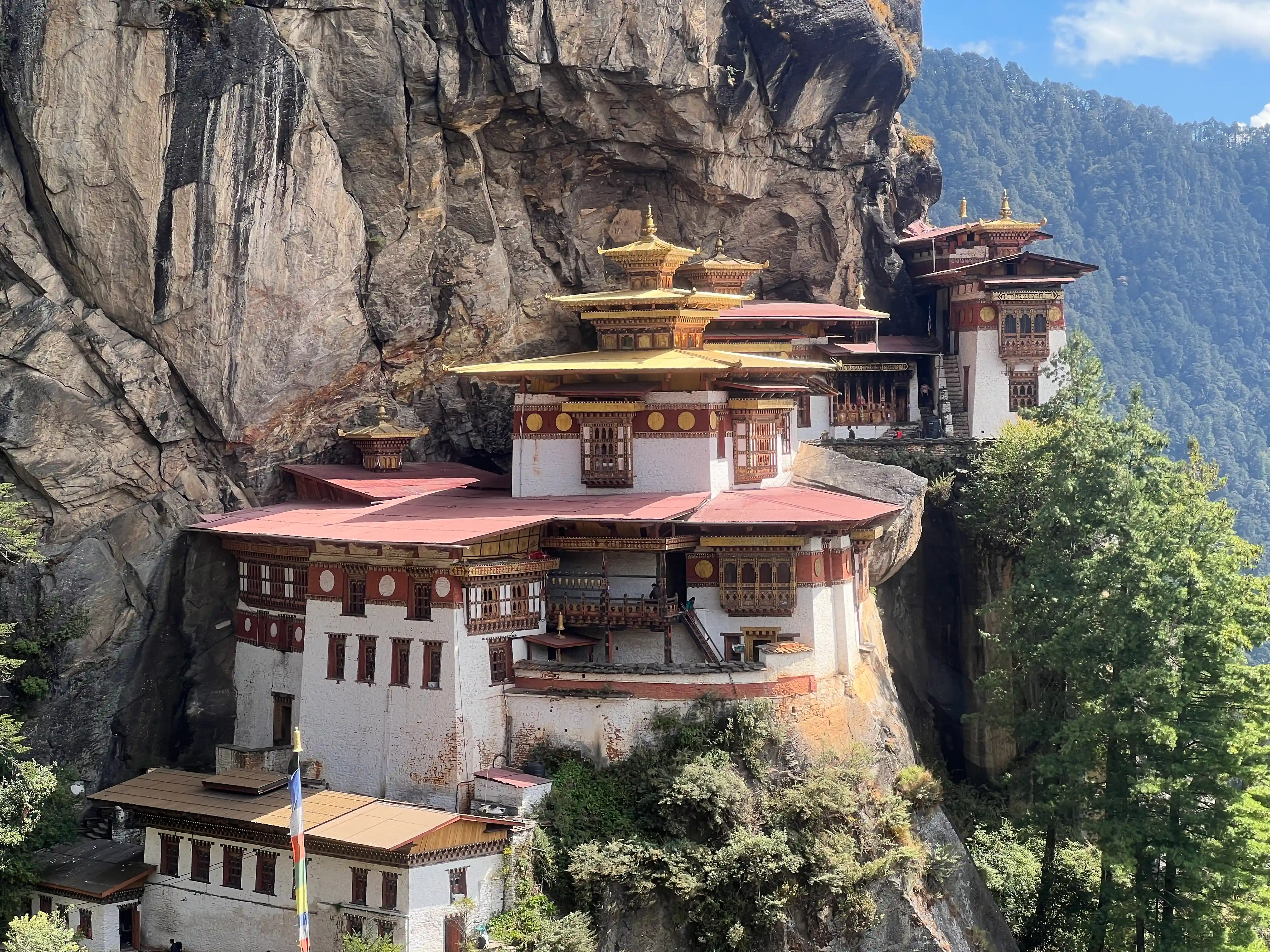
After breakfast excursion to Taktsang Monastery or Tiger’s Nest (approx. 5 hours walk): It is one of the most famous of Bhutan’s monasteries, perched on the side of a cliff 900m above the Paro valley floor. It is said that Guru Rinpoche arrived here on the back of a tigress and meditated at this monastery and hence it is called ‘Tiger’s Nest’. This site has been recognised as a most sacred place and visited by ShabdrungNgawangNamgyal in 1646 and now visited by all Bhutanese at least once in their lifetime. On 19 April 1998, a fire severely damaged the main structure of the building but now this Bhutanese jewel has been restored to its original splendour.
Afternoon drive to Drukgyel Dzong, a ruined fortress where Bhutanese warriors fought Tibetan invaders centuries ago. The snowy dome of sacred Chomolhari, the "mountain of goddess'' can be seen in all her glory from the approach road to the Dzong.
Later, visit the 7th-century Kyichu Lhakhang, one of the 108 temples built in the Himalayas by the Tibetan King, Songtsen Gampo. The building of this temple marks the introduction of Buddhism in Bhutan.
Overnight at the hotel in Paro.
DAY 05 DEPART PARO
After early breakfast at the hotel, drive to the airport for flight to your onward destination. Our representative will help you with exit formalities and then bid you farewell.